Here is a list of resources that I have been compiling over the years. Most of them are links to texts and curriculum from all over Latin America. Enjoy!
Son antologías que se usan en países de habla hispana de primer grado a 6to grado
|
El Salvador
|
Home » Posts tagged 'escritura'
Here is a list of resources that I have been compiling over the years. Most of them are links to texts and curriculum from all over Latin America. Enjoy!
Son antologías que se usan en países de habla hispana de primer grado a 6to grado
|
El Salvador
|
If you have not seen these please take a look: Graphic Organizers. Estas ayudas gráficas están disponibles en español también.
Any time we can help students organize their thinking, plan their learning, make their learning visible, we are helping them build connections and increase the number of synapses– that is learning! With graphic organizers we can increase literacy, too.
Literacy Creates Justice!

You are right- I never explained this!
In a guided reading group one of the goals is to have students read text while supported by you, the teacher. Remember the idea of gradual release of responsibility:
Using staggered-start can be both of the last two bullets; the key is that the student is ‘doing’ while you watch or help:
Did that make sense? The idea is that each student starts and continues reading through to the end. Because each student begins at a different time, each one has to appropriately-struggle with the whole text. No one is getting nervous about everyone listening; no one is counting ahead and pre-reading his or her paragraph. This is not round-robin reading!
As coach, you cue students as they are reading and take notes about their struggles. I always ask students to use their finger or a ruler while they are stagger reading so that I, the teacher, know where they are on the page and I can match the text with their speech as I quickly check in with each student.
Remember, this is one step in a whole process; it is one way to have students practice their reading in a guided reading group. Staggered reading will mean nothing if students do not understand what they are reading. Reading= comprehension.
Literacy Creates Justice (and it’s fun!).
Here is a group of teachers practicing staggered reading:
Please be aware of the Global Goals for Sustainable Development. You can find more information here: https://www.tes.com/worldslargestlesson/ and you can choose your language in the upper right hand corner. This is important!!
La lección más grande del mundo
 If you are interested in how Reader’s and Writer’s Workshop works in one school in Minnesota, check out the site Literacy @ Riverview. The site gives an outline of expectations for reading and writing education. It is a great site for new teachers who want a window into elementary literacy or experienced teachers who want a refresher. There is also a section of resources in Spanish.
Check it out and see what you think:
https://sites.google.com/a/stpaul.k12.mn.us/riverview-literacy/
At La Cosecha I learned a new vocabulary-practice strategy: Thumb Challenge!

Create a game board for each pair of students. The example in the picture used two crowns from Burger King (sorry about the glare). Along each side have the same set of vocabulary words and the word start. You could attach the words with tape, velcro, sticky notes. Then:
Options: Use a third person to serve as the judge, deciding if the definition and usage are correct. Let students use notebooks and environmental print to aid them
Here is a fun, new graphic organizer: The Consequence Wheel/ Ripple Effect.

Use this to help students see consequences of events, understand cause and effect, … Try it and see if it works for you
When teaching writing in elementary and middle school, one of the challenges is how to keep moving forward with the different genre studies (narrative, expository and opinion … and don’t forget poetry!) while giving students the differentiated instruction that they need. At La Cosecha I learned of a way to do just that.
Using the units proposed by Lucy Calkins or the units created by your district (or by you) the first step is to begin each unit using a simple prompt that will let you complete a pre-assessment to find out what the students already know. You can assess their writing using the rubric to guide your instruction during the unit. My experience has been, though, that those first drafts show too many holes to be of much use; the students need instruction in many areas.
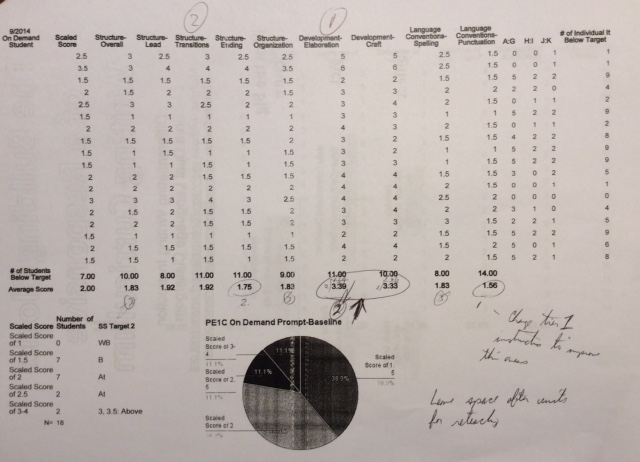 Then, after teaching the unit while referring often to the rubric and publishing a final draft, use the same prompt you used at the beginning of the unit. This time, it is important to use the rubric to deeply analyze the writing. The first thing you will most likely notice is a vast improvement over the initial use of the prompt. However, if you use the rubric and turn the information into numbers (see image to the right) you will see trends including areas that need specific attention.
This is where the differentiation can happen. Based on the needs you notice, you can form groups of students for differentiated instruction just as you would do during reader’s workshop. This small group work could happen during the first week of the next unit or you could schedule a week in between each unit for the differentiated instruction. Use the CCSS to decide which areas are of greatest need. You might also decide that a change in tier 1 instruction would be most appropriate (e.g. focus on punctuation during morning meeting). You can let this assessment guide you during the next unit of study.
One more idea that I loved: sketch the story then touch and tell. Oral rehearsal!
Resources: Lucy Calkins: Writing Pathways, WIDA Writing Rubric
I heard of a new (for me) resource while at La Cosecha 2104: Words in Motion.
“Words in Motion is a cognate-based curriculum that introduces academic vocabulary in meaningful contexts and promotes strategies for academic vocabulary acquisition.
“The full curriculum consists of seven units that include lesson plans, teacher materials, and student worksheets for each day. The materials are organized first by unit; within each unit they are organized by day; and within each day they are organized into lesson plans, student materials, and teacher materials. In many cases, there are separate materials for the monolingual and crosslinguistic versions of the curriculum, as well as Spanish translations of the crosslinguistic versions to support the delivery of the bilingual version. The VIAS team is pleased to provide these files for use by educators.” (from the CAL website: http://www.cal.org/vias/subproject4/wmc/index.html )
This could be used by classroom teachers and/ or ESL teachers to help students acquire academic vocabulary. Check it out!
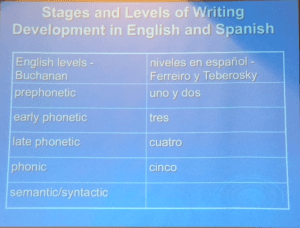 At La Cosecha 2014 I attended a session by Freeman and Freeman. Loved it! Here is a copy of their handout that I downloaded from the conference website: Writing handout- Freeman.
The presentation was a summary of part of the text, Teaching Reading and Writing in Spanish and English which is also available in Spanish. Looking at the writing children do while knowing the stages teachers can admire the amazing work that students do while coaching them on to the next level.
A few highlights:
As a teacher, I love coaching writers because it involves all four modalities of language- speaking, listening, reading and writing. Students tell their story (or information), they write it, they read it back while listening to their work. Then they revise.
 S. T. Fleming