Speaking to My Children- What Language?

The short answer is: speak to your children in the language you know best.  Oral language is the precursor to all literacy skills:

  • What you can think, you can say;
  • what you say you can write;
  • what you can write you can read.

When parents ask me what language they should use with their children I consistently tell them to use the language they know best.  Most of the time the parents are non-English speakers wondering if they should speak with their children using the little English they know.  “No,” I tell them.

When children are offered rich language in extended discourse they develop amazing vocabularies and complex sentences.  If their caregivers offer them limited vocabulary and limited discourse that is what the children will develop.  Because literacy skills transfer, the extended discourse will transfer once the children have the necessary vocabulary in the new language… but they can’t transfer what they do not know.

  • Speak to your children often and listen to their answers.
  • Have them tell you stories and ask follow-up questions.
  • Ask open ended questions (questions that require more than yes or no).
  • Ask them to explain more or tell you what that means.
  • Give them new vocabulary as you ask them questions and respond to their stories:
    • Child: I used that thing to cut cheese.
    • Adult: Oh, you used the cheese slicer.
    • Child: Yes, I used the cheese slicer and I cut a lot of cheese.
  • When you read with your children ask them questions such as:
    • What do you think will happen next?
    • Would you have done that?
    • How would you solve the problem?
    • Tell me the story
    • Talk, talk, talk!

There is much research about the importance of oral language.  Give your child the gift of language through conversation and story telling.

Literacy creates justice!
Almost

I almost had a new student last week. Almost.

Here in Lima I am beginning my own business as a teacher of English. I would like it to expand to reading and writing instruction as well but what Peruvians want most is to be able to hold conversations in English and pass standardized tests such as the TOEFL. OK, I can help with that.

With business cards printed I began to advertise in local shops by pinning my card to bulletin boards and talking to some of the shop owners. I don’t want to advertise too far away because traffic here is a bear!

Later that afternoon the phone rang. An unknown number on my new cell phone! It must be a new student; wow, that was quick! I just put the cards up.

“Where are you? I am here in Calle 10. Can I come over now?” the voice on the other end asked rather urgently.

Because I am on 10th street too I answered, “Sure, let’s meet by the flag poles out front in the park.”

A few minutes later we were sitting on the park bench out front discussing English. “Tell me a bit about yourself,” I began.

“I am originally from the Dominican Republic and I am here in Peru with a construction company. The bosses at the company want me to learn English; it is the only way I can rise to the next level. Right now I know hardly any English so I want to start as soon as possible.”

We discussed how best to get started and decided on one hour a day every day Monday through Friday. Then he pulled out his wallet. He wanted to pay me in advance for next week’s classes. I felt uncomfortable with that. When I lived in Chile and began my English teaching business there I found that there were students with whom I could not work so I wanted to have at least one class before any money exchanged hands. As I listened, I also wondered if he were really a Dominican. I lived with a Dominican for three years and this voice sounded different.

The Dominican was rather insistent. He opened his wallet showing two hundred dollar bills saying, “If I pay now I will be more committed to the work of learning English.”

“Sir, I won’t take any money today and I don’t have change.” I was more insistent. “Let’s meet on Monday and see how things go.”

“OK.” We shook hands and he continued on his way.

On Monday evening I showed up at the appointed time and place. No one was there. I called the number he had given me. Wrong number. I almost had a new student. Almost.

What happened, you ask? After many conversations with family and friends here in Lima we came to the conclusion that the Dominican wanted to pay me with counterfeit bills and receive the change in real Peruvian money. I was on the wrong end of a scam. Almost.

Lima Sky: Panza de Burro

Speaking with someone here in Lima, Peru I asked about the weather.  You see, my experience of Lima has generally been in the winter months (June, July, August).  During that time the sky is usually gray and the sun is rarely seen.  Now it is spring and the sky is still mostly gray.

When I asked about the summer months and the presence or absence of the sun I was told, “No, el cielo panza de burro se cambia en el verano.  En el verano hay sol y hace calor.”  That means, ‘No, the sky that looks like the belly of a burro changes in the summer.  In the summer there is sun and it is hot.”

I was so glad to hear that I will see more sun and I loved the description of the sky: panza de burro/ belly of a burro (also known as a donkey).

The World’s Largest Lesson

Please be aware of the Global Goals for Sustainable Development.  You can find more information here: https://www.tes.com/worldslargestlesson/ and you can choose your language in the upper right hand corner.  This is important!!

La lección más grande del mundo

http://www.youtube.com/watch?v=iLjFg-xUzaQ

How to Write a Travel Article

Part 1: Introduction

What is the goal of the introduction?                            http://goo.gl/QJmVUU

How do I start?

1 more way to begin…

https://stfleming.com/2015/09/28/travel-article-2/ 

Now in Peru!

Last Thursday night we arrived in Lima, Peru!  This will be home for the foreseeable future.

We have been enjoying the company of family and friends; we have been searching out places to live; we have been learning from and working with some amazing people; we have been looking for and creating work, ways to share what we know while continuing to grow in knowledge.

There are amazing possibilities in this city of 10 million!  If you are looking for a literacy/ language teacher and coach please let me know; I would love to talk to you about the possibilities.

Empanada Recipe

IngredientsDouble recipe!
2 pounds ground beef
2 or 3 chopped onions
3 or 4 chopped garlic cloves
2 T oil
½ c raisins
¼ t paprika
½ t cumin
½ t oregano
1 t salt
½ t pepper
1 can of black olives
4 hard-boiled eggs
1 beaten egg
(All of the spice quantities can change according to your taste.)

For the filling…
Soak the raisins in hot water for about an hour.  In a large frying pan fry the ground beef in the oil until browned.  Add the chopped onions and minced garlic and cook until the onions are mostly transparent.  Add cumin, oregano, salt, pepper and paprika (optional) and cook for three minutes.  Let the filling cool (overnight in fridge or just a few hours until cool).  Slice the eggs.

Dough for the crust
3 c flour
1 t salt
1 t baking powder
¼ c melted shortening
¼ c melted butter
¾ c warm milk + ¼ c warm water (or 1 c warm milk)

Mix the flour with the salt and baking powder.  Add the shortening, butter, milk and water.  Mix well, kneading until soft and flexible but not sticky.  Let rest for ½ hour and divide into 16 portions, ready for rolling out. (This number is flexible depending on the size of your empanadas)

To fill the crust…
Pre-heat the oven to 400º F.

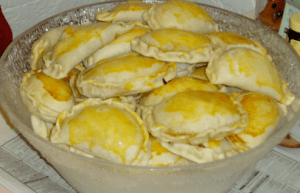
With a rolling pin stretch each piece of dough and cut into a circle.  Begin filling the empanadas by putting the meat mixture in the middle of the dough; then add one slice of egg, a few raisins and 2 olive halves.  Wet the edges of the dough and close the dough, flipping over one half onto the other half and pinch the now moistened edges.  Lightly brush each empanada with raw egg (beaten).  Poke each empanada with a fork a few times, this reduces the inside pressure when cooking and helps prevent bursting at the seams.

Place on cookie sheet and bake for 20 minutes (until golden brown).   Let cool a bit before eating.

Yum!

The Basics

I have been volunteering at a wonderful school in Lima, Peru and am reminded of some universal basics in education:

  • Have an objective;
  • Teach to the objective- use a text, activity, … to teach the objective remembering that the text is not the objective;
  • Evaluate whether or not the objective was met;
  • Reteach or move forward depending on the assessment.

When teaching I need to let the students do the work- talk, write, create, use the information- so they can show what they know and are able to do.  I love the workshop model where I give some input for no more than 15 minutes and then have the students use the information.  Then, I can provide more input.  Build up scaffolding and then remove it when it is no longer necessary.

I also like to backwards plan my units where I decide what I want the students to know and be able to do by what date.  Then, I backwards plan the lessons necessary to get them there.  And of course, relationships are key.

¡Feliz día del maestro amigos peruanos!  Happy Teacher’s Day to my Peruvian friends!