Just in time for St. Patrick’s Day I offer my mom’s Irish Soda Bread recipe… again. Enjoy!
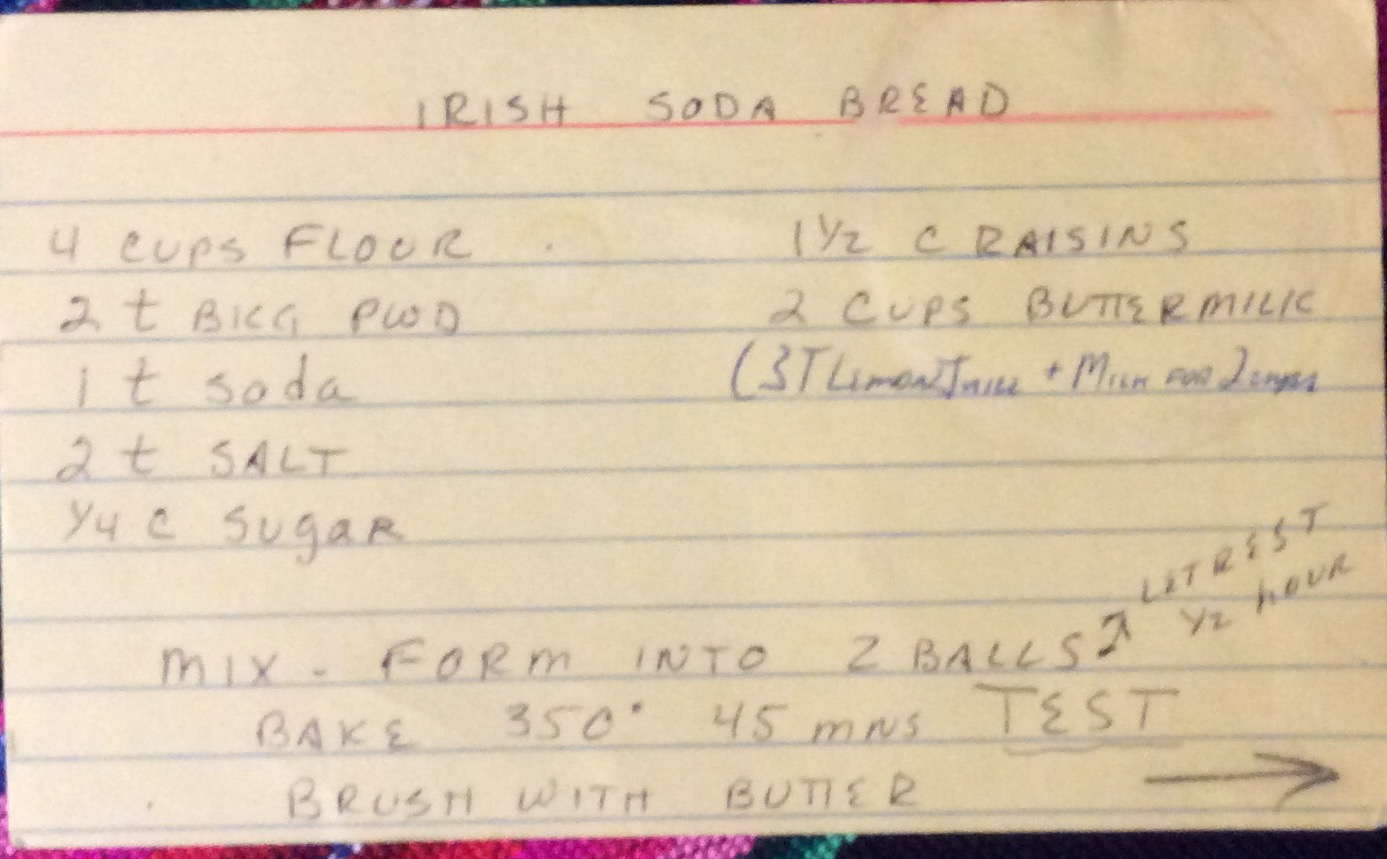 Mmmmmm!
Home » Articles posted by stfleming (Page 15)
Author Archives: stfleming
After Her Death
Following my mother’s death
We fought about the things.
We argued over furniture and
Heirloom diamond rings.
The Waterford from Ireland,
And oil-on-canvas art,
Madam Alexander Dolls,
Keepsakes of the heart.
Two lifetimes worth of Kodak prints,
The sweaters knit by hand,
Great grandma’s China gravy boat,
Old stories of the land.
____________
“My shelves are full!”
“My car’s too small!”
“Antique things’ll break!”
“I’ve got no room
On floor or wall
So nothing will I take!”
That’s the way we argued,
Voices almost at a wail.
So then and there we opted
For a discount two-day sale.
The Tooth Fairy: A True Story
Last Friday I read a story with a first grade student during his independent reading time. Actually, he read to me a story of the Tooth Fairy. His ancestors of a few generations back came from Mexico (that will matter towards the end of this commentary).
Here is our conversation after he finished reading the story:
Student: I know that the Tooth Fairy is not real.
Me: No? (I know that this student has older siblings and I wondered what they had told him.)
Student: No. It’s not real.
Me: What more can you tell me?
Student: No, it’s not a fairy. It’s a ratoncito. This is true! In parts of Latin America it is not a fairy that leaves coins for a tooth it is a Ratoncito Pérez.
The Cupboard
The ratty kitchen cupboard door
stood open every morning.
And everyday I told my kid,
“This is your final warning!
“You have to, must and always will
keep spices from the light
within the safety of the doors,
the cupboard closed up tight!”
“Sorry pop, it wasn’t me,”
the youngest one would say.
“I’d never harm the cinnamon.”
One day he moved away.
That open kitchen cupboard door
kept pestering my life.
Mistake! for it was not my child:
Was my forgetful wife.
“Oh honey, dear, please help me out
and do me a big favor:
Please close the cupboard door at night
so spices we can savor.”
“Don’t ‘honey me’ with open doors;
forgetful I am not.
I, too, protect the tarragon
and rind of apricot.”
After many years of open doors
she passed while sound asleep.
I cried for days, din’t eat a bite,
spent nights a‘counting sheep.
Then hunger knocked one afternoon,
I craved a spicy stew.
Aghast! the cupboard doors thrown wide!
I din’t know what to do!
***********
The cupboard doors I had removed,
And now I clearly see:
T’was not my son nor lovely wife,
The guilty one was me
Writing Poem for Year’s End
Writing for year’s end
On paper thinking, today reflecting
Aimless thoughts a wander.
Judging not the honesty of this day,
The moment,
Tomorrow’s truth might morph.
But today I write
and today I know
I know
today.
Differentiated Instruction
Yes! Differentiated instruction is important. Students need the opportunity to learn and show their learning in ways that are appropriate and motivating for them.
For a humorous take on differentiated instruction, watch this video:
The Joy of Books!
Welcome MTSS!
Today the vertical team, the multi-tiered system of support, is visiting our school. This is a great opportunity to get feedback on what we are doing well and where we need to improve. Specialists in areas of literacy, math, behavior, special ed., ESL, pre-K and kindergarten, … come to spend the day to see what/ how we are doing.
Some of the teachers and staff may get nervous when there are visitors. Me? I like feedback… especially when it is professional and leads toward growth.
Thumb Challenge!
At La Cosecha I learned a new vocabulary-practice strategy: Thumb Challenge!

Create a game board for each pair of students. The example in the picture used two crowns from Burger King (sorry about the glare). Along each side have the same set of vocabulary words and the word start. You could attach the words with tape, velcro, sticky notes. Then:
- Have each pair of students sit knee-to-knee;
- Place their thumbs at the starting line;
- Partner A moves his/ her thumb to the first word and challenges partner B to define the word and use it in a sentence;
- If partner B is correct, partner A asks about the next word; if not partner B asks partner A about the first word;
- If neither partner can define/ use the word they need to get assistance.
Options: Use a third person to serve as the judge, deciding if the definition and usage are correct. Let students use notebooks and environmental print to aid them
 S. T. Fleming