Writing in English/ Escribiendo en español

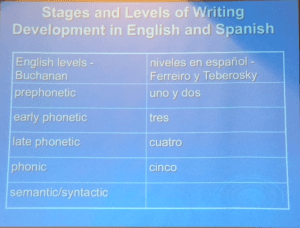
Stages NivelesAt La Cosecha 2014 I attended a session by Freeman and Freeman.  Loved it! Here is a copy of their handout that I downloaded from the conference website: Writing handout- Freeman.

The presentation was a summary of part of the text, Teaching Reading and Writing in Spanish and English which is also available in Spanish.  Looking at the writing children do while knowing the stages teachers can admire the amazing work that students do while coaching them on to the next level.

A few highlights:

  • Drawing is the starting of writing;
  • Student scribbles mirror the environmental print they see around themselves;
  • As very beginning writers, students may use the letters in their name, perhaps the only letters they know at first, to represent all letters;
  • In English students learn consonant sounds first- in Spanish they learn vowels;
  • As students work out consistency they may spell the same word in many different ways in the same sentence or paragraph;
  • All students can be accepted where they are and coached to higher stages.

As a teacher, I love coaching writers because it involves all four modalities of language- speaking, listening, reading and writing.  Students tell their story (or information), they write it, they read it back while listening to their work.  Then they revise.

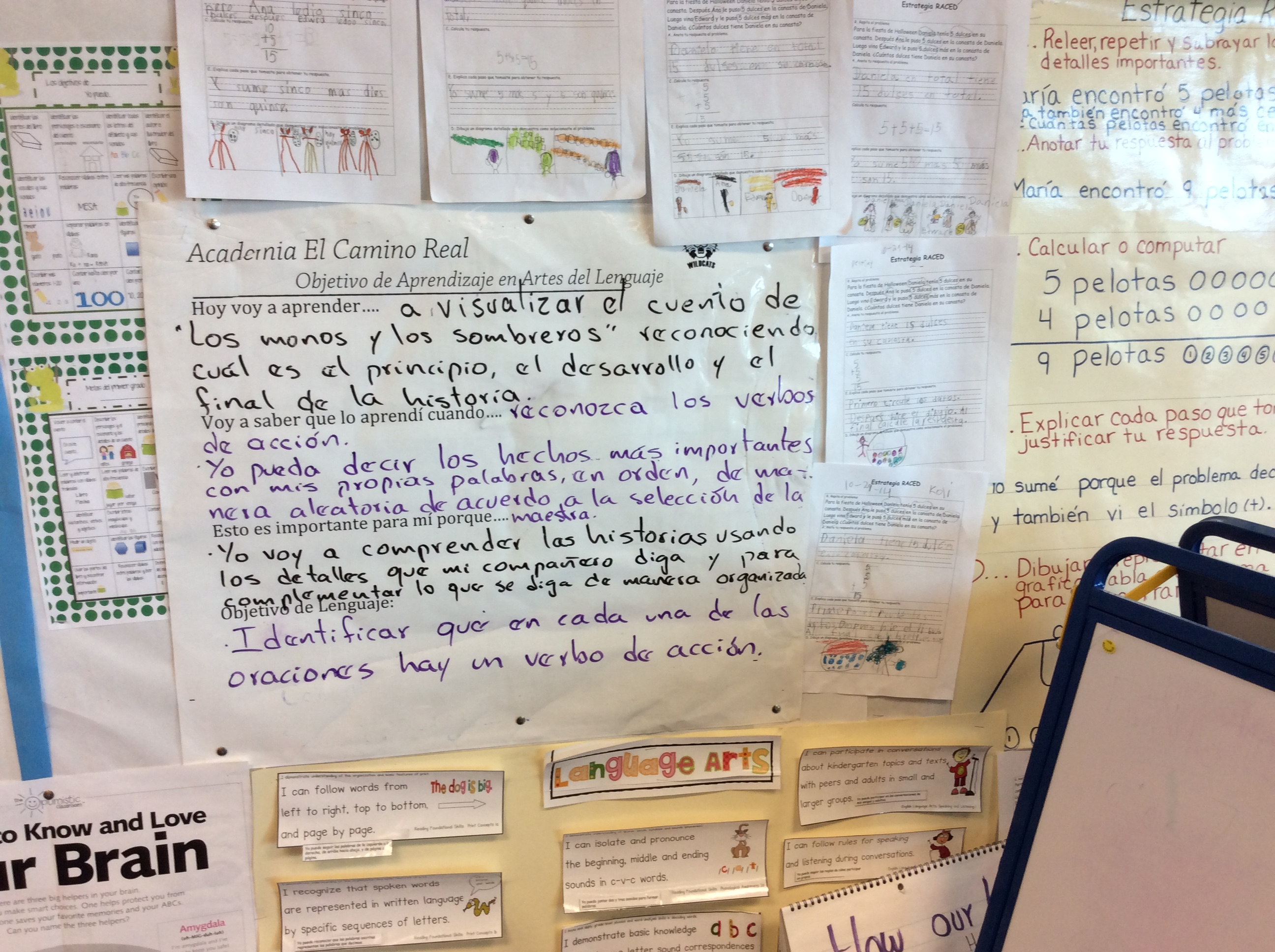
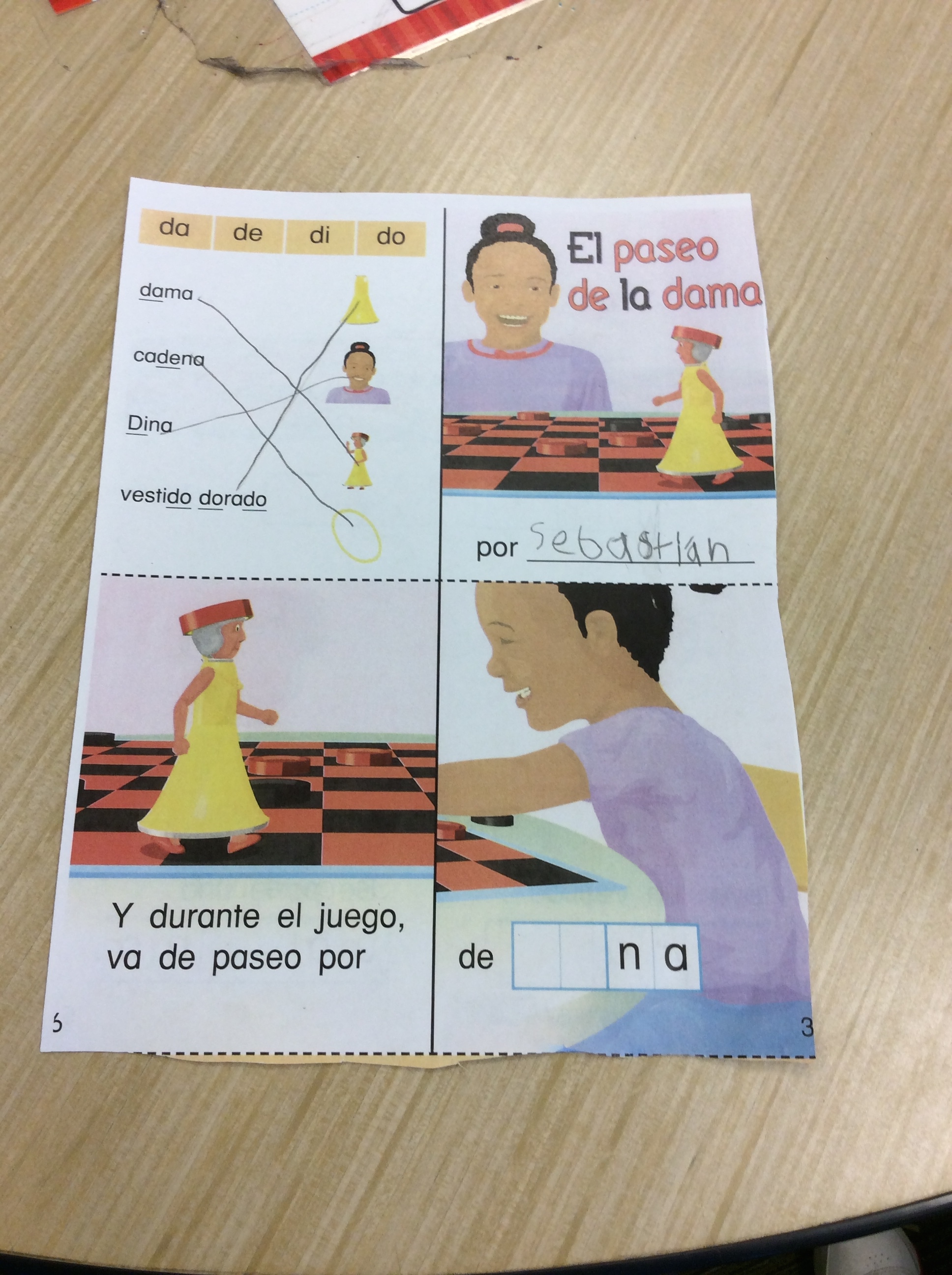
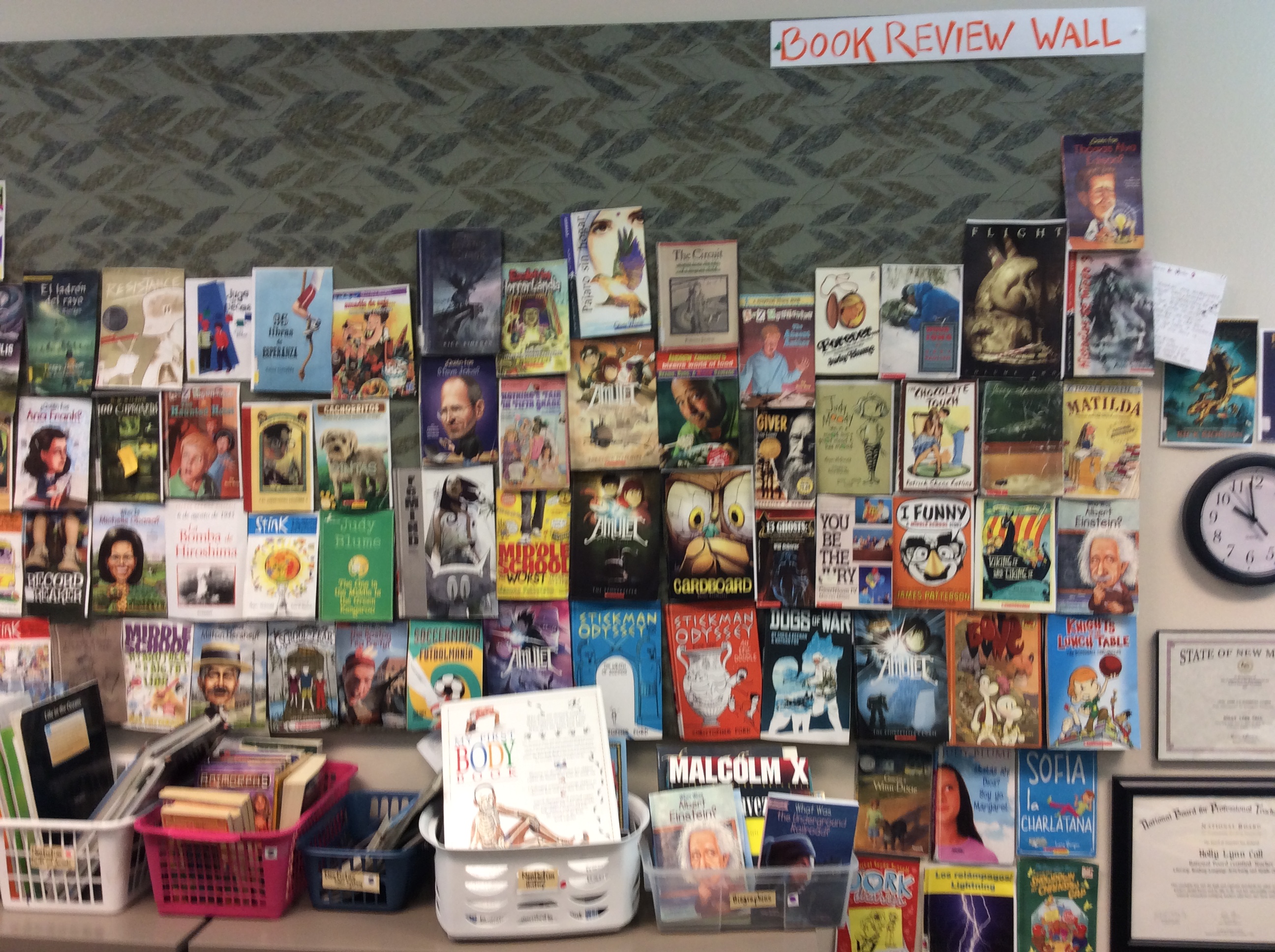
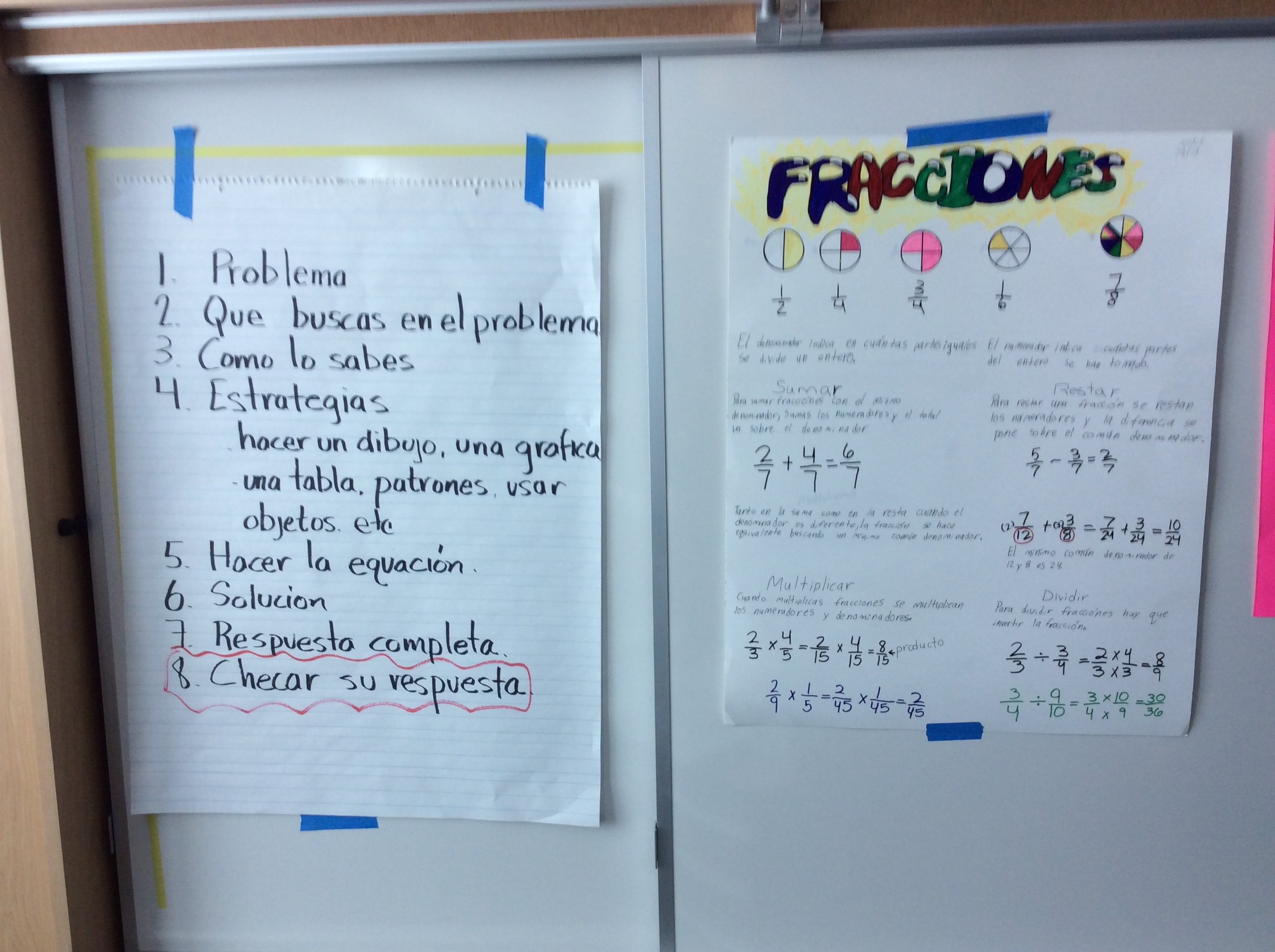
Visit to El Camino Real Academy, Santa Fe, NM (La Cosecha 2014)

We had a wonderful visit today to El Camino Real Academy in Santa Fe, NM as part of La Cosecha 2014.  Here are some pictures of artifacts that I saw.  The first 8 are from Kindergarten and 1st grade; the others are from 6th and 7th grade.

IMG_0113 IMG_0112 IMG_0109 IMG_0108 IMG_0107 IMG_0106 IMG_0105 IMG_0104


IMG_0103 IMG_0102 IMG_0100

Centros de aprendizaje (lectura)

Algunas ideas para centros de aprendizaje:
(se puede añadir ideas, cambiar ideas, juntar ideas, …)

Es importante enseñar y practicar cada centro de aprendizaje antes de que los estudiantes lo hagan solitos.

Formando palabras
Usando las sílabas que han aprendido, estudiantes forman palabras juntando papelitos que tienen las sílabas escritas. Durante su tiempo en el grupo tienen que formar 10 palabras reales, escribir las en un papel o en su cuaderno y dibujar tres; pueden añadir 5 no-palabras (sílabas que han juntado que pueden decir pero que no son palabras reales: “me-pe”).

Escuchar y contar
Estudiantes escuchan/ leen un cuento. Después, tienen que contar el cuento usando las frases, “Al principio…, Después… y Al final… .” Pueden usar títeres si son disponibles.

¡PUF veloz!
Usando un cronómetro, estudiantes repasan las palabras de uso frecuente que han aprendido para ver si pueden decirlas cada vez más rápido. Uno compite contra uno mismo, no contra otros estudiantes. Pueden escribir su tiempo y/o las palabras que no sabían en una hoja o en su cuaderno.

Rimas
Estudiantes elijen una palabra de un montoncito y tiene que decir y escribir 5 palabras que riman; la meta es que 4 de los 5 sean palabras reales. Después tienen que marcar las palabra que no es una palabra real. Añade un cronómetro para otro desafío.

Leyendo con pareja
Estudiantes leen un libro juntos alternando:
Una página cada uno;
Una oración cada uno;
Una palabra cada uno.
Después cuentan el cuento o dibujan su parte favorita.

Los libros de la maestra
En este centro los estudiantes re-leen los textos que la maestra ha leído en lecciones de lectura compartida, rimas que han estudiado, canciones que han aprendido… cualquier texto que la maestra ha leído con el grupo (“Big books,” “charts,”…)

On the Border

Many people do things that are illegal. Most people speed in their cars; many people drink before their 21st birthday. Some parents will even say that their children are only 11 when they are really 12 so they can pay less to watch a movie. I won’t mention the more serious crimes of which we are all aware.

The crime that people are guilty of when they are in the United States illegally is Entering Without Inspection. This is a misdemeanor crime. That means that it is a minor crime like underage drinking or petty theft. When people cross the border into the United States they are required to check in with Homeland Security.

When a person does not check in with the border patrol they do not become illegal anymore than an underage drinker becomes illegal. A person cannot be illegal. A person can do something illegal; a person can be in the country illegally. A person cannot be illegal.

We would do well to welcome the stranger, believe that all life is sacred and ask some questions. Why do people want to come into the United States? What responsibility do we, as citizens and residents of the United States, have for the conditions in their home country? What responsibility does our government have? Leaving home for a foreign land is never a decision taken lightly. An easy first step we can take in this matter is to treat all with dignity and never refer to a human being as illegal.

Comment posted on NYTimes.com

The Basics

I have been volunteering at a wonderful school in Lima, Peru and am reminded of some universal basics in education:

  • Have an objective;
  • Teach to the objective- use a text, activity, … to teach the objective remembering that the text is not the objective;
  • Evaluate whether or not the objective was met;
  • Reteach or move forward depending on the assessment.

When teaching I need to let the students do the work- talk, write, create, use the information- so they can show what they know and are able to do.  I love the workshop model where I give some input for no more than 15 minutes and then have the students use the information.  Then, I can provide more input.  Build up scaffolding and then remove it when it is no longer necessary.

I also like to backwards plan my units where I decide what I want the students to know and be able to do by what date.  Then, I backwards plan the lessons necessary to get them there.  And of course, relationships are key.

¡Feliz día del maestro amigos peruanos!  Happy Teacher’s Day to my Peruvian friends!

New Header- ¡Biblioburro!

The new picture above is of the Biblioburro.  Have you heard of it?  Do a Google search and you will see/ hear/ read about this amazing project in Colombia.  I believe in the power of books and literacy to change the world.  Take a look at this YouTube video to get started on your learning about Biblioburro.

How will you change the world? Y tu, ¿cómo vas a cambiar el mundo?

I know him, I don’t know him

Mr. B walked a kindergarden student to his room where I was working as the guest teacher for the day.  The 6 year old was surprised to see me and not his usual teacher.  Mr. B asked the student, “Do you know Mr. Fleming?”

“Yes, I know him.”

“Are you ready to have a good day with him, learn a lot and follow the instructions he gives?”

“Well, I’m not sure.  He’s old.  And I don’t know him.”

Kindergarten or Middle School

This week I have been learning about a new way of teaching kindergarten that my school district is implementing.  I don’t know much about kindergarten and I know even less about kindergarteners so, there is a lot for me to learn.  About the first ten years of my teaching was in middle school and then mostly 4th and 5th since then.

I commented to a colleague about my lack of knowledge/ experience with 5 and 6 year olds.  She asked, “But you know a lot about middle schoolers, don’t you?”

“Yes, I do,” I answered.

“They are very similar: unpredictable, variable moods, they want to be grown up  and little kids at the same time, they learn fast, they say everything they think without filtering, they want life to be fair and consistent,” and on she described the wonderful, amazing middle schoolers I have worked with (with whom I have worked!).

I think I will have to spend some more time with 5 and 6 year olds and see if she is right. What do you think?  Is my colleague right?

“Too Much” Corrections

I was co-teaching in a 5th grade writer’s workshop today; we are working on memoirs.  I overheard a student tell the teacher, “I don’t want to work with Mr. Fleming.  He corrects me too much.”

That got me wondering, am I offering too many corrections?  In my conversation with the student we reviewed the difference between a story and a memoir; she understood well the concept.  Then I asked her, “What could you add to your conclusion to…” and before I finished she answered, “I need to tell how I learned that lesson when that event happened.”

“Yes!” I replied.

“Should I mention that learning at the beginning so the reader knows where I am headed?”  Clearly she had overheard my previous conversations.

“Yes.  Go to it.”

So, I don’t think I offered too many corrections.  I believe that she evaluated her work and found a few holes in her writing on her own.  I confirmed her evaluation and sent her on her way.  The problem was that she did not want to make the additions.  But that’s OK, I have yet to meet a 5th grader who likes to make corrections (and I haven’t met too many adults who like to make corrections either).