Unexpected Amazed

As I knelt to plant my vegetable garden
the sown seeds, unexpectedly, had been mixed
At some point
by no one in particular
A loose box, open envelopes, perhaps

The vegetables were few and far between
But the flowers
The flowers
They were beautiful mixed with greens
Unexpected
Beautiful

When I stood to paint this mural
To reflect the sea and the sunset
The waves and the gulls
A sudden elbow slip, a few misstrokes
new-strokes
And the sea became a flowing river
All re-framed
With tall buildings reflecting the sky
Beautiful
Unexpected yet
Beautiful 

Sitting at the piano bench to write
The song of minor tones and sadness
Oops, a major third, hmmm, a new progression
With a walking bass line
And a piano solo
Jazzy
Classy
Unexpected and beautiful 

Lettings loose the best of creation
Rolling with the punches
Not knowing the end result
Why did the character sneeze?
Why did the colors blend?
Why did the music roll?

Ahh, the way of creation
Beautiful and unexpected
And beautiful
Accepted and beautiful
For if the end were pre conceived
Would it be art?
Would it be creation?
Would it be life?

Unexpected beauty happens
Be amazed!

Sites for Spanish Literacy Games

I have been gathering websites for early literacy learning in Spanish; here they are… so far.  clearly I need to annotate the list and add more.

If you have any other suggestions please let me know; I am sure there are many, many more.

Writer’s Workshop Ideas- Fun, Engaging

A colleague in my K- 5 school asked for a few ideas about making writer’s workshop fun and engaging.  I love those questions because it allows me to be creative and gather ideas.  Here are a few ideas to get started… (If you have more please add them!)

  • Be passionate- write in front of the students and let them see you write and talk out loud about your process, about spelling, …
  • Draw pictures to go with the writing
  • Write stories to go with the pictures
  • Make comic books
  • Re-write comic books (the one you just made or one that was professionally made) into story format with dialogue and description
  • Let students write what they want- lists, stories, opinions, how-to, all I know about…, non-fiction or fiction, poems, … play with words
  • Find a real audience- another classroom, the hallway, a classroom in another school or another city, country, a blog, …
  • Design/ diagram something invented and explain how it works
  • Read/ tell the beginning of a story and have the students continue/ finish it
  • Act out a story and then have the students write the script
  • Write a script and then have the students act it out, or with puppets, or as a podcast or …
  • Writing prompts
  • Connect writing closely with reading or science or social studies
  • Shared writing
  • Do you have a class mascot (stuffed animal, live animal, …)?  Write the stories of the mascot- where from, past adventures, include pictures,
  • Class blog on kidblog.org
  • Add podcasts of students reading their writing on your page of the school’s website
  • Check out blog posts such as: http://tunstalltimes.blogspot.com/2014/08/engaging-writing-activities.html
  • Stick with the standards but let your mind wander and your creativity soar

The Tooth Fairy: A True Story

Last Friday I read a story with a first grade student during his independent reading time. Actually, he read to me a story of the Tooth Fairy.  His ancestors of a few generations back came from Mexico (that will matter towards the end of this commentary).

Here is our conversation after he finished reading the story:

Student: I know that the Tooth Fairy is not real.
Me: No?  (I know that this student has older siblings and I wondered what they had told him.)
Student: No.  It’s not real.
Me:  What more can you tell me?
Student: No, it’s not a fairy.  It’s a ratoncito. This is true!  In parts of Latin America it is not a fairy that leaves coins for a tooth it is a Ratoncito Pérez.

Differentiated Instruction

Yes!  Differentiated instruction is important.  Students need the opportunity to learn and show their learning in ways that are appropriate and motivating for them.

For a humorous take on differentiated instruction, watch this video:

Thumb Challenge!

At La Cosecha I learned a new vocabulary-practice strategy: Thumb Challenge!

pic03925

Create a game board for each pair of students.  The example in the picture used two crowns from Burger King (sorry about the glare).  Along each side have the same set of vocabulary words and the word start. You could attach the words with tape, velcro, sticky notes. Then:

  • Have each pair of students sit knee-to-knee;
  • Place their thumbs at the starting line;
  • Partner A moves his/ her thumb to the first word and challenges partner B to define the word and use it in a sentence;
  • If partner B is correct, partner A asks about the next word; if not partner B asks partner A about the first word;
  • If neither partner can define/ use the word they need to get assistance.

Options: Use a third person to serve as the judge, deciding if the definition and usage are correct. Let students use notebooks and environmental print to aid them

Consequence Wheel

Here is a fun, new graphic organizer:  The Consequence Wheel/ Ripple Effect.

Consequence Wheel

  • Put the topic in the middle;
  • Add the consequences in the first ring;
  • Add the details, both positive and negative in the next ring.

Use this to help students see consequences of events, understand cause and effect, …  Try it and see if it works for you

Differentiated Writing Instruction

When teaching writing in elementary and middle school, one of the challenges is how to keep moving forward with the different genre studies (narrative, expository and opinion … and don’t forget poetry!) while giving students the differentiated instruction that they need.  At La Cosecha I learned of a way to do just that.

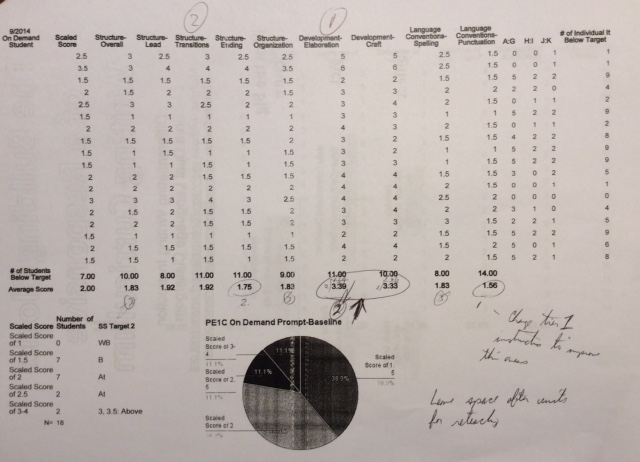
Using the units proposed by Lucy Calkins or the units created by your district (or by you) the first step is to begin each unit using a simple prompt that will let you complete a pre-assessment to find out what the students already know.  You can assess their writing using the rubric to guide your instruction during the unit.  My experience has been, though, that those first drafts show too many holes to be of much use; the students need instruction in many areas.

pic26633Then, after teaching the unit while referring often to the rubric and publishing a final draft, use the same prompt you used at the beginning of the unit.  This time, it is important to use the rubric to deeply analyze the writing.  The first thing you will most likely notice is a vast improvement over the initial use of the prompt.  However, if you use the rubric and turn the information into numbers (see image to the right) you will see trends including areas that need specific attention.

This is where the differentiation can happen.  Based on the needs you notice, you can form groups of students for differentiated instruction just as you would do during reader’s workshop.  This small group work could happen during the first week of the next unit or you could schedule a week in between each unit for the differentiated instruction.  Use the CCSS to decide which areas are of greatest need.  You might also decide that a change in tier 1 instruction would be most appropriate (e.g. focus on punctuation during morning meeting).  You can let this assessment guide you during the next unit of study.

One more idea that I loved: sketch the story then touch and tell.  Oral rehearsal!

Resources: Lucy Calkins: Writing Pathways, WIDA Writing Rubric


Words in Motion

I heard of a new (for me) resource while at La Cosecha 2104: Words in Motion.

Words in Motion is a cognate-based curriculum that introduces academic vocabulary in meaningful contexts and promotes strategies for academic vocabulary acquisition.

“The full curriculum consists of seven units that include lesson plans, teacher materials, and student worksheets for each day. The materials are organized first by unit; within each unit they are organized by day; and within each day they are organized into lesson plans, student materials, and teacher materials. In many cases, there are separate materials for the monolingual and crosslinguistic versions of the curriculum, as well as Spanish translations of the crosslinguistic versions to support the delivery of the bilingual version. The VIAS team is pleased to provide these files for use by educators.” (from the CAL website:  http://www.cal.org/vias/subproject4/wmc/index.html )

This could be used by classroom teachers and/ or ESL teachers to help students acquire academic vocabulary.  Check it out!