Writing in English/ Escribiendo en español

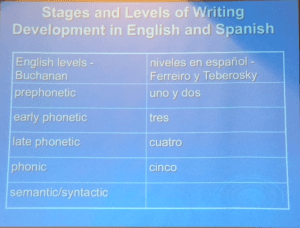
Stages NivelesAt La Cosecha 2014 I attended a session by Freeman and Freeman.  Loved it! Here is a copy of their handout that I downloaded from the conference website: Writing handout- Freeman.

The presentation was a summary of part of the text, Teaching Reading and Writing in Spanish and English which is also available in Spanish.  Looking at the writing children do while knowing the stages teachers can admire the amazing work that students do while coaching them on to the next level.

A few highlights:

  • Drawing is the starting of writing;
  • Student scribbles mirror the environmental print they see around themselves;
  • As very beginning writers, students may use the letters in their name, perhaps the only letters they know at first, to represent all letters;
  • In English students learn consonant sounds first- in Spanish they learn vowels;
  • As students work out consistency they may spell the same word in many different ways in the same sentence or paragraph;
  • All students can be accepted where they are and coached to higher stages.

As a teacher, I love coaching writers because it involves all four modalities of language- speaking, listening, reading and writing.  Students tell their story (or information), they write it, they read it back while listening to their work.  Then they revise.

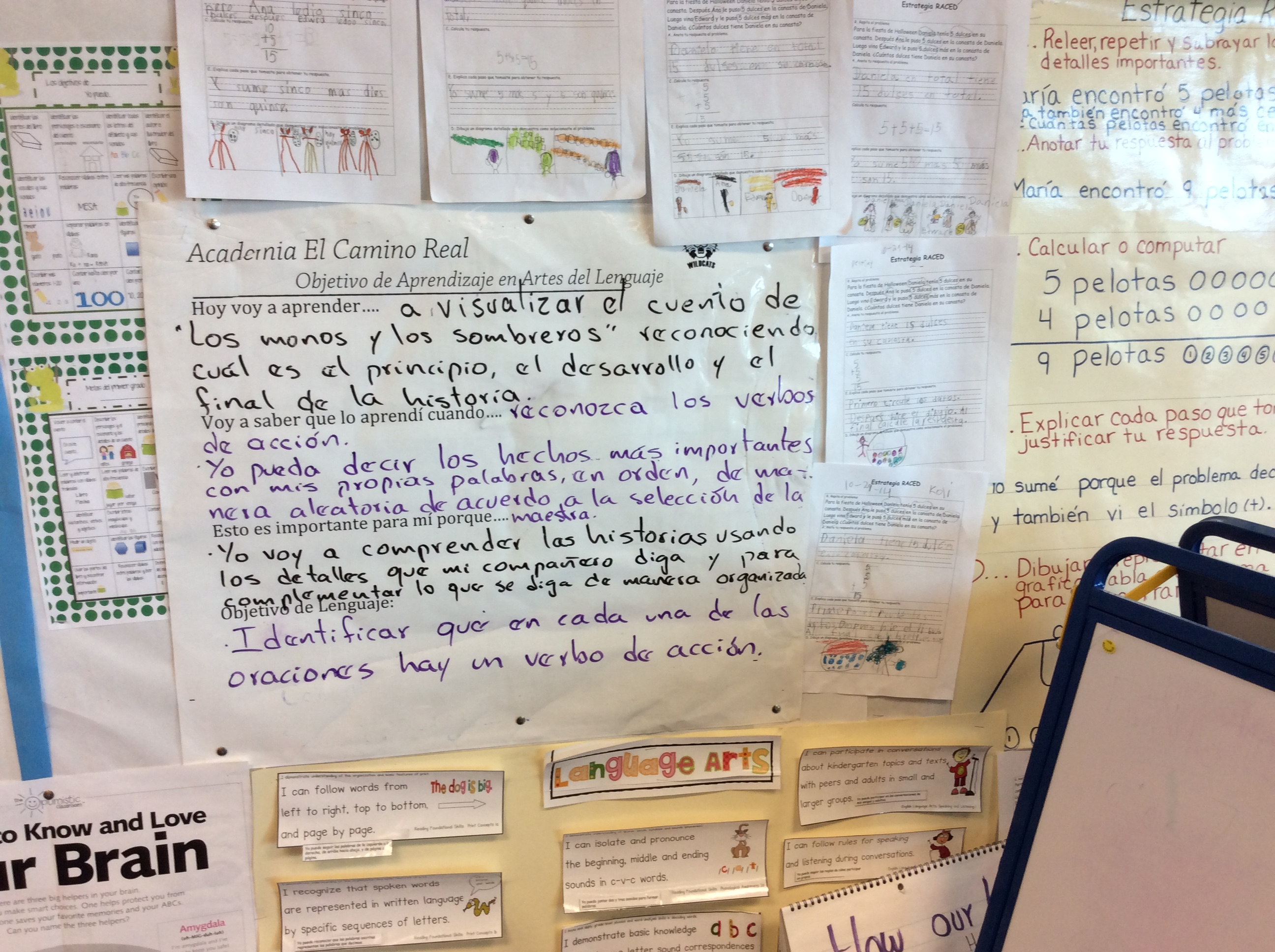
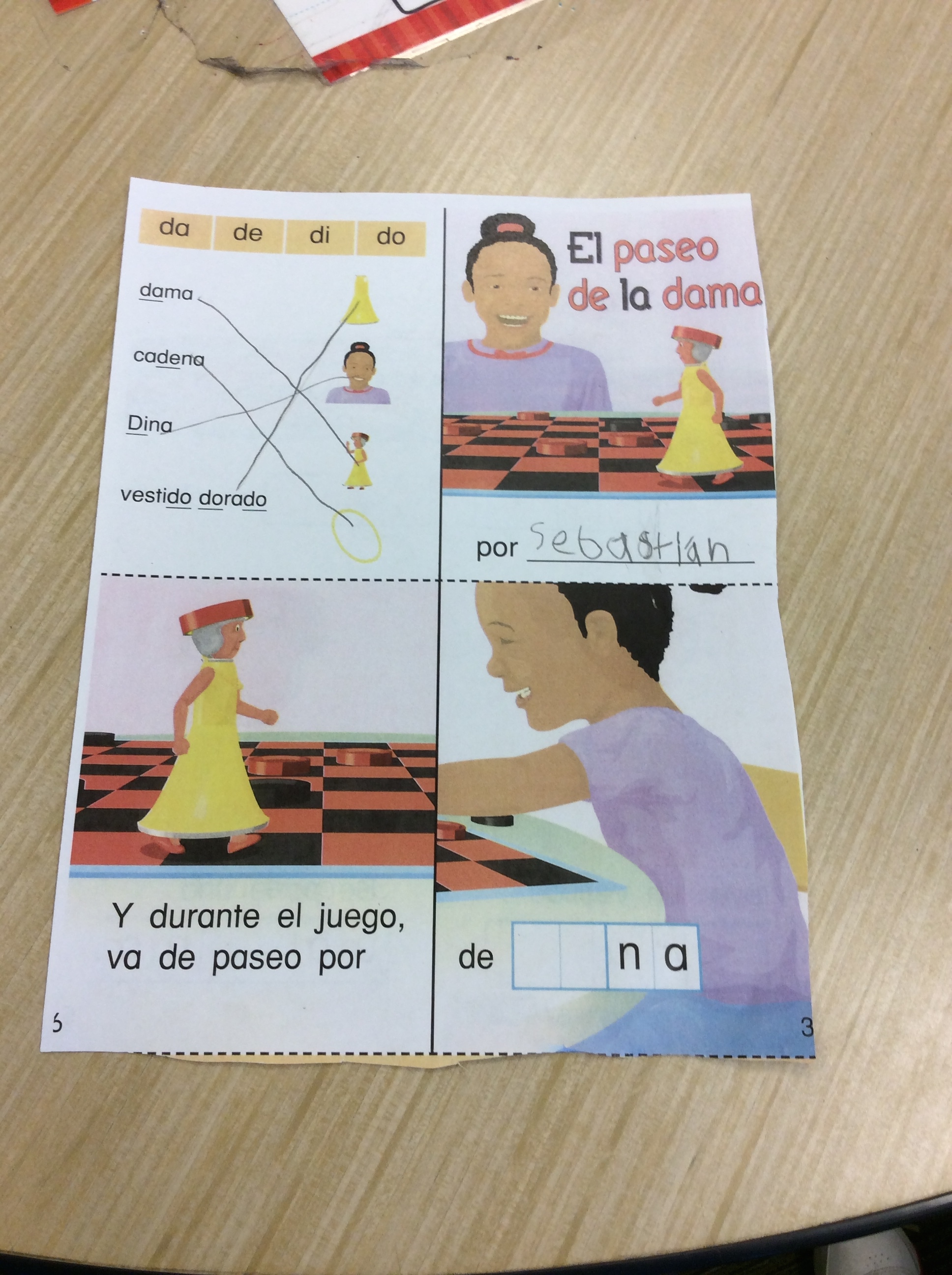
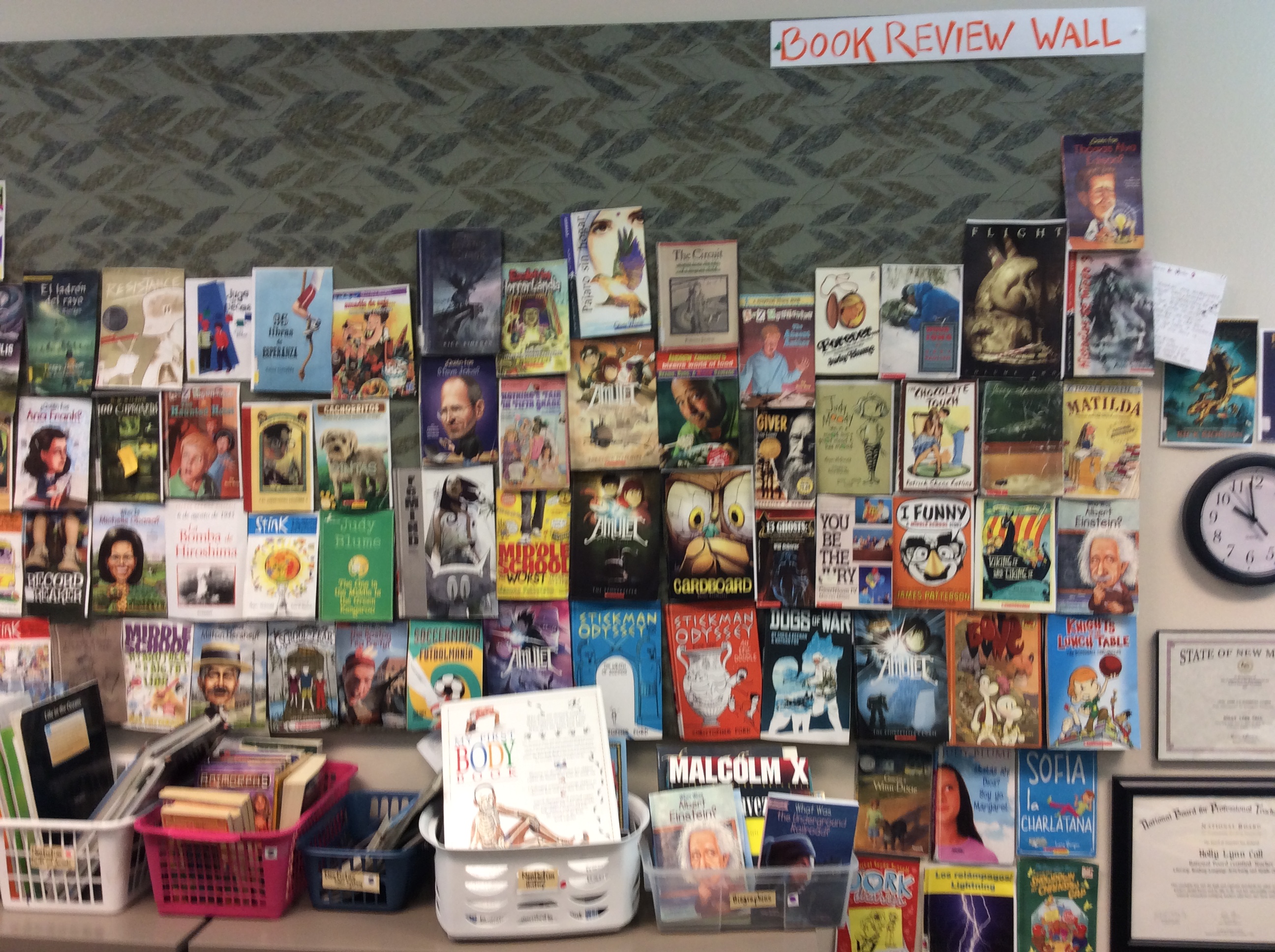
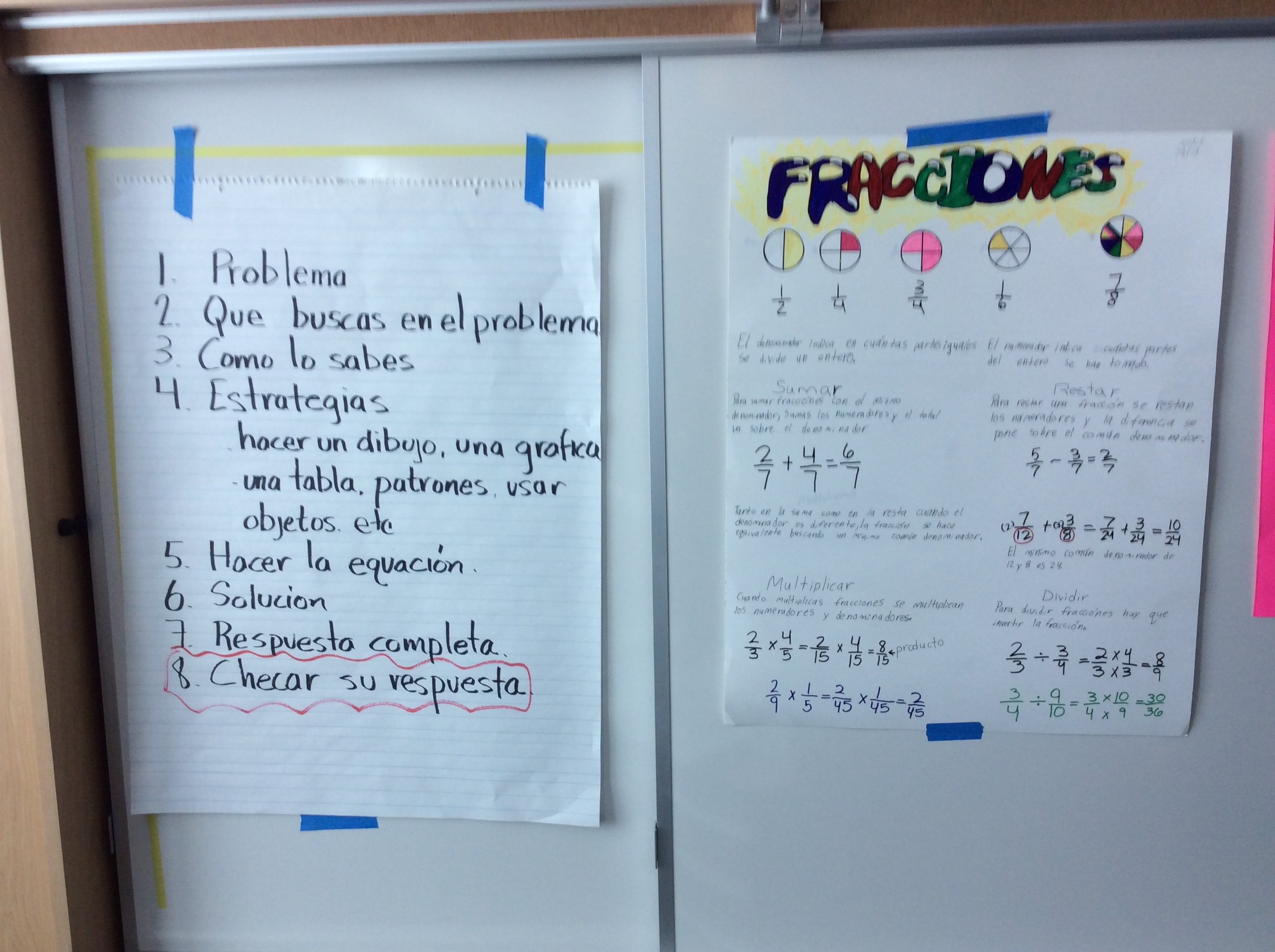
Visit to El Camino Real Academy, Santa Fe, NM (La Cosecha 2014)

We had a wonderful visit today to El Camino Real Academy in Santa Fe, NM as part of La Cosecha 2014.  Here are some pictures of artifacts that I saw.  The first 8 are from Kindergarten and 1st grade; the others are from 6th and 7th grade.

IMG_0113 IMG_0112 IMG_0109 IMG_0108 IMG_0107 IMG_0106 IMG_0105 IMG_0104


IMG_0103 IMG_0102 IMG_0100

Centros de aprendizaje (lectura)

Algunas ideas para centros de aprendizaje:
(se puede añadir ideas, cambiar ideas, juntar ideas, …)

Es importante enseñar y practicar cada centro de aprendizaje antes de que los estudiantes lo hagan solitos.

Formando palabras
Usando las sílabas que han aprendido, estudiantes forman palabras juntando papelitos que tienen las sílabas escritas. Durante su tiempo en el grupo tienen que formar 10 palabras reales, escribir las en un papel o en su cuaderno y dibujar tres; pueden añadir 5 no-palabras (sílabas que han juntado que pueden decir pero que no son palabras reales: “me-pe”).

Escuchar y contar
Estudiantes escuchan/ leen un cuento. Después, tienen que contar el cuento usando las frases, “Al principio…, Después… y Al final… .” Pueden usar títeres si son disponibles.

¡PUF veloz!
Usando un cronómetro, estudiantes repasan las palabras de uso frecuente que han aprendido para ver si pueden decirlas cada vez más rápido. Uno compite contra uno mismo, no contra otros estudiantes. Pueden escribir su tiempo y/o las palabras que no sabían en una hoja o en su cuaderno.

Rimas
Estudiantes elijen una palabra de un montoncito y tiene que decir y escribir 5 palabras que riman; la meta es que 4 de los 5 sean palabras reales. Después tienen que marcar las palabra que no es una palabra real. Añade un cronómetro para otro desafío.

Leyendo con pareja
Estudiantes leen un libro juntos alternando:
Una página cada uno;
Una oración cada uno;
Una palabra cada uno.
Después cuentan el cuento o dibujan su parte favorita.

Los libros de la maestra
En este centro los estudiantes re-leen los textos que la maestra ha leído en lecciones de lectura compartida, rimas que han estudiado, canciones que han aprendido… cualquier texto que la maestra ha leído con el grupo (“Big books,” “charts,”…)

The Basics

I have been volunteering at a wonderful school in Lima, Peru and am reminded of some universal basics in education:

  • Have an objective;
  • Teach to the objective- use a text, activity, … to teach the objective remembering that the text is not the objective;
  • Evaluate whether or not the objective was met;
  • Reteach or move forward depending on the assessment.

When teaching I need to let the students do the work- talk, write, create, use the information- so they can show what they know and are able to do.  I love the workshop model where I give some input for no more than 15 minutes and then have the students use the information.  Then, I can provide more input.  Build up scaffolding and then remove it when it is no longer necessary.

I also like to backwards plan my units where I decide what I want the students to know and be able to do by what date.  Then, I backwards plan the lessons necessary to get them there.  And of course, relationships are key.

¡Feliz día del maestro amigos peruanos!  Happy Teacher’s Day to my Peruvian friends!

New Header- ¡Biblioburro!

The new picture above is of the Biblioburro.  Have you heard of it?  Do a Google search and you will see/ hear/ read about this amazing project in Colombia.  I believe in the power of books and literacy to change the world.  Take a look at this YouTube video to get started on your learning about Biblioburro.

How will you change the world? Y tu, ¿cómo vas a cambiar el mundo?

Making Content Accessible

All teachers who have Emerging Bilinguals (a.k.a ESL students) in their classrooms are immersion teachers.  That is, their students are immersed in English when that is not one of the languages the students know.

Often I am asked, “How do I change my instruction to make the content accessible to my emerging bilinguals?”  Below I have begun a list of ideas (most are not mine

Instructional Practices to Make Content Accessible

  • Use a variety of techniques responding to different learning styles and language proficiency levels.
  • Build and maintain positive interactions between teachers and students and among students.
  • Implement a reciprocal interaction model of teaching – genuine dialog.

Cooperative learning or group work situations, including…

  • Students work interdependently on tasks with common objectives.
  • Individual accountability, social equity in groups and classroom- everyone can do something.  (Have you seen the WIDA Can-Do descriptors?)
  • Extensive interactions among students to develop bilingualism.

Language input that…

  • Uses sheltering strategies to promote comprehension (see below)
  • Uses visual aids and modeling instruction, allowing students to negotiate meaning
  • Is interesting, relevant, of sufficient quantity
  • Is challenging to promote high levels of language proficiency and critical thinking
  • Language objectives are integrated into curriculum, including:
    • Structured tasks and unstructured opportunities for students to use language
    • Language policy to encourage students to use instructional language
    • Monolingual lesson delivery by the teacher
    • Students’ use of their L1 as needed to make meaning
    • Needs of all students are balanced
    • Students are integrated for the majority of the instruction

In the early stages of second language acquisition, input is made more comprehensible though the use of:

  • slower, more expanded, simplified, and repetitive speech oriented to the “here and now” (Krashen, 1981; Long, 1980),
  • highly contextualized language and gestures (Long, 1980; Saville-Troike, 1987),
  • comprehension and confirmation checks (Long, 1980), and,
  • communication structured to provide scaffolding for the negotiation of meaning by L2 students by constraining possible interpretations of sequence, role, and intent (SavilleTroike, 1987).

Sheltered techniques include:

  • the use of visual aids such as pictures, charts, graphs, and semantic mapping,
  • modeling of instruction, allowing students to negotiate meaning and make connections between course content and prior knowledge,
  • allowing students to act as mediators and facilitators,
  • the use of alternative assessments to check comprehension,
  • portfolios,
  • use of comprehensible input, scaffolding, and supplemental materials, and
  • a wide range of presentation strategies.

Transition Words in Spanish

When writing realistic fiction (I teaching in 4th grade) there are ways to make your paragraphs flow more smoothly from one to the next.  One way is to use transition words.  I found and added to a list of transition words (palabras de transición).

Try them out in your Spanish writing and see how your paragraphs flow

Here they are:

Para demostrar secuencia

al principio                   luego                        antes       después                         en seguida

Para demostrar contraste o cambio de idea:

por el contrario            sin embargo            al mismo tiempo         en contraste              por otro lado de otro modo                   a pesar de (que)            al contrario        de otra manera                aunque 

 Para demostrar adición o complemento de una idea:

también                          lo siguiente                  seguidamente
de igual importancia           de la misma manera          igualmente
además / por otra par   del mismo modo

 Para demostrar resultado:

en consecuencia           obviamente

de tal manera que             en cualquier caso
por esta razón                 evidentemente
por consiguiente           además
como resultado de         de hecho

Para evidenciar tiempo:

inmediatamente            después
tan pronto como           a más tardar
posteriormente             antes de
previamente

St. Paul Hmong two-way immersion programs

The folks at the Twin Cities Daily Planet had a nice article about St. Paul Hmong two-way immersion programs.  The title made it seem like there were problems but the article was well written.  And we all know, if we’ve read the research, that immersion works!

Keep up the good work, Jackson and Phalen!

More Advantages of Being Bilingual: The Sharper Minds of Bilinguals

Study: The Sharper Minds of Bilinguals – Learning the Language – Education Week.

There are more and more studies about the advantages of being bilingual.  Above you will find a link to yet another study.  Most bilingual folks I know are not surprised, nor are the teachers in dual language programs- like the amazing teachers in the St. Paul Public Schools Dual Language Programs.

Now I would like to see more and more studies about the best types of programs for creating bilingual students.  One- way programs?  Two-way programs?  How many minutes per day in each language? in each subject?  How does homework play into the mix?  What is the best use of technology in dual language programs?

Perhaps we will never find the perfect ‘program’ but we can continue to empower teachers to create an environment that will lower the affective filter, scaffold instruction, teach language through content and motivate students to read, learn, question and create.