When I lived in Latin America people would often say, “We are poor because they are rich.” The reference connected the poor of the global south to the rich of the global north. The popular wisdom (and authors such as Eduardo Galeano) had it right all along.
How do children acquire language? Lots of language, written language, spoken language?
Dr. Kate Kinsella gave an interesting talk last year at the Minnesota ESL, Bilingual and Migrant Education Conference. Here is the link to her page from the conference. Check out the handouts for some amazing ideas for language acquisition: http://www.mnellconference.org/?page_id=9
Thrilled was I to read in the Star Tribune (Minneapolis, MN) about the failed effort to ban a book, Eleanor and Park. Books should not be banned. Period.
Yes, there are difficult themes in books. But there are difficult themes in life. Yes, there are offensive themes in books. But there are offensive themes in life. In the hands of a skilled educator, a reflective parent, any book can be a source of learning; it can lead to discussion and consideration of life and what kind of world we want to live in and create, just by our living.
When writing realistic fiction (I teaching in 4th grade) there are ways to make your paragraphs flow more smoothly from one to the next. One way is to use transition words. I found and added to a list of transition words (palabras de transición).
Try them out in your Spanish writing and see how your paragraphs flow
Here they are:
Para demostrar secuencia
al principio luego antes después en seguida
Para demostrar contraste o cambio de idea:
por el contrario sin embargo al mismo tiempo en contraste por otro lado de otro modo a pesar de (que) al contrariode otra manera aunque
Para demostrar adición o complemento de una idea:
también lo siguiente seguidamente
de igual importancia de la misma manera igualmente
además / por otra par del mismo modo
Para demostrar resultado:
en consecuencia obviamente
de tal manera que en cualquier caso
por esta razón evidentemente
por consiguiente además
como resultado de de hecho
Para evidenciar tiempo:
inmediatamente después
tan pronto como a más tardar
posteriormente antes de
previamente
I have been working with a group of teachers to create a rubric for the reader’s workshop work time. We are looking at the possibilities of ramping up our practice. See what you think:
From http://www.devstu.org/research-individualized-daily-reading
Have you seen this? Amazing! Let’s read more!
“Anderson, Wilson, and Fielding (1988) led one of the most extensive studies of independent reading in which they investigated the relationship of reading time to reading achievement. The study found that the amount of time students spent reading independently was the best predictor of vocabulary development and reading achievement gains.
“The research indicates that independent reading is probably the major source of vocabulary acquisition beyond the beginning stages of learning to read. Students who read more can learn the meanings of thousands of new words each year.
“The chart below shows the high impact of independent reading time to word exposure and the percentile of reading achievement.”
The Herdmans are the worst kids in the history of the world. They lie, steal, smoke cigars, swear, and hit little kids. So no one is prepared when this outlaw family invades church one Sunday and decides to take over the annual Christmas pageant.
None of the Herdmans has ever heard the Christmas story before. Their interpretation of the tale — the Wise Men are a bunch of dirty spies and Herod needs a good beating — has a lot of people up in arms. But it will make this year’s pageant the most unusual anyone has seen and, just possibly, the best one ever.
Did you ever wonder why the days are so long in the summer and so short in the winter? In the summer, around June 21 or 22, we experience the summer solstice, which is the longest day of the year. And in the winter, December 21 or 22 is the winter solstice, or shortest day.
But wait! If you live in Australia, you experience the opposite—the longest day is in December and the shortest is in June. Why?
Earth’s Angle
The answer all depends on Earth’s tilt. In the course of one year, Earth orbits around the sun. It does not complete this trip, however, with the North Pole at the top and the South Pole at the bottom because Earth is tilted. In fact, it’s tilted just about 23.5º. So at different times of the year, either the northern or the southern hemisphere is tilted toward and is therefore closer to the sun.
So if you live in the northern hemisphere (north of the equator), Earth is tilted toward the sun in the summer and away from the sun in the winter. The solstice marks the turning point, when the days begin to grow longer (in the winter) or when they begin to grow shorter (in the summer). At the solstice itself, however, the sun appears to stand still in the sky for a few days before and after. The word solstice, in fact, comes from the Latin for sun + to stand still.
Reasons for Seasons
But then why, if the solstice is the turning point, is June 21st considered the first day of summer and December 21st thefirst day of winter? This odd fact is because while the hours of daylight are changing, the oceans need to catch up. Oceans take a long time to heat up and cool down (something called thermal inertia). In June, they are still cool from the winter, so the warmest days happen in July and August. (Have you ever gone swimming off Cape Cod in June? Brrrr!) Similarly, the oceans hold onto the warmth of summer long after the barbeques have ended. So the coldest days usually happen in January and February. (Again, everything is reversed if you live below the equator.)
Even stranger, Earth is closest to the sun between January 3 and 5, but since the northern hemisphere is tilted away from the sun, the nights are long and the weather is cold.
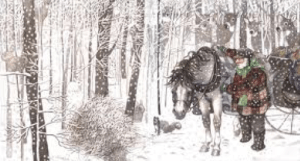 Stopping by Woods on a Snowy Evening by Robert Frost
 S. T. Fleming